Sustainable balls that actually play like tournament balls — no compromises required.
Written by a 6.0+ DUPR, Top 100 professional pickleball player.
Pickleball's growth has a hidden cost: by industry estimates, more than 550 million balls are produced every year, and because a standard ball is a single piece of hard petroleum-based plastic, nearly every cracked one goes straight to a landfill. A new generation of eco-friendly pickleballs — 3D printed from recycled material, molded from biodegradable plastics, or made with recycled content — now meets regulation specs, and several carry USA Pickleball approval.
To find the best of them, we evaluated eco balls on performance (bounce, flight, spin), durability, materials and end-of-life claims, certification, and value, drawing on independent testing claims, player reviews, and USA Pickleball approval status. Here are the five that earned a spot.
Our Top Picks
- Best Overall: CORE ECO Biodegradable Pickleballs
- Runner-Up, Best Overall: Komodo BioBall
- Third Place: Evolute EV-11
- Best Innovation / Most Durable: Accel Digital Sports DigiPro 3.0
- Best for Fast, Aggressive Play: Accel Digital Sports DigiPro 3.1 Fast-Play
- Best for Bulk Buyers: CORE ECO Bulk Packs
Best Overall: CORE ECO Biodegradable Pickleballs
$10.99 per 3-pack (~$3.66/ball)
What We Like
- USAPA tournament-approved from an established ball brand — an official ball of sanctioned events, including the Pickleball World Cup
- Biodegradability certified by ASTM testing — fully decomposes in about 400 days
- Plays like the conventional CORE tournament ball it's based on: true bounce, honest spin, familiar pace
- Most affordable entry point into certified eco balls, in high-visibility neon
What to Consider
- Durability is comparable to standard balls, not multiples better
- Sold direct from CORE and select retailers; in-store availability is still growing
The CORE ECO takes the top spot because it's the eco ball that asks for zero compromise and zero leap of faith. CORE is a known quantity in tournament balls, so you're not gambling on a startup's quality control — the ECO bounces, flies, and wears like the conventional CORE ball it's built on, and it carries full USAPA tournament approval. Its sustainability story is also the best-documented in the category: a modified 100% biodegradable plastic whose ~400-day decomposition is certified by ASTM testing rather than a marketing page. At $10.99 for three, it's also the cheapest way on this list to make the switch. Tournament pedigree, third-party paperwork, and a lunch-money price: that's the complete package, and the ball we'd hand to any player making the change.
Key Specs: 40-hole outdoor design | Certified biodegradable plastic (ASTM tested, ~400 days) | USAPA approved | Sold in 3-packs
Runner-Up, Best Overall: Komodo BioBall
~$14.99 per 4-pack (bulk discounts to ~$12.74/pack)
What We Like
- USA Pickleball approved for sanctioned play
- Up to 5x more durable than traditional balls — up to ~70 games per ball
- Breaks down in landfill conditions in an estimated 3–5 years, verified by independent scientific testing
- Priced within about a dollar of standard tournament ball packs
What to Consider
- 4-ball packs only; no large bulk cases yet
- Biodegradation is measured in years, not months
The BioBall is a very close second, and the durability leader among conventionally priced balls. It checks nearly every box: USAPA approval so it's legal wherever a ball isn't mandated, a durability claim that flips the sustainability math in your favor (one BioBall outlasting a stack of conventional balls keeps that whole stack out of the trash), and a price that removes the "green tax" excuse. It plays like a proper outdoor ball — regulation bounce, stable flight — and when it finally dies, it's engineered to break down entirely within three to five years under normal U.S. landfill conditions rather than persisting for centuries. If ball longevity is your top criterion and you don't need the CORE's tournament pedigree, this is your pick.
Key Specs: 40-hole outdoor design | Biodegradable bio-based construction | USAPA approved | Sold in 4-packs
Third Place: Evolute EV-11
$42.00 per 12-pack (~$3.50/ball); 3-packs also available
What We Like
- Incorporates 10% reclaimed ocean-bound plastic
- Made from #2 MDPE, a fully recyclable material — cracked balls can enter the recycling stream
- Pro-level durability and consistent bounce
- Priced in line with conventional tournament balls
What to Consider
- 10% reclaimed content means 90% isn't — this is incremental sustainability, not a biodegradable ball
- Recycling #2 plastic still depends on your local facility accepting it
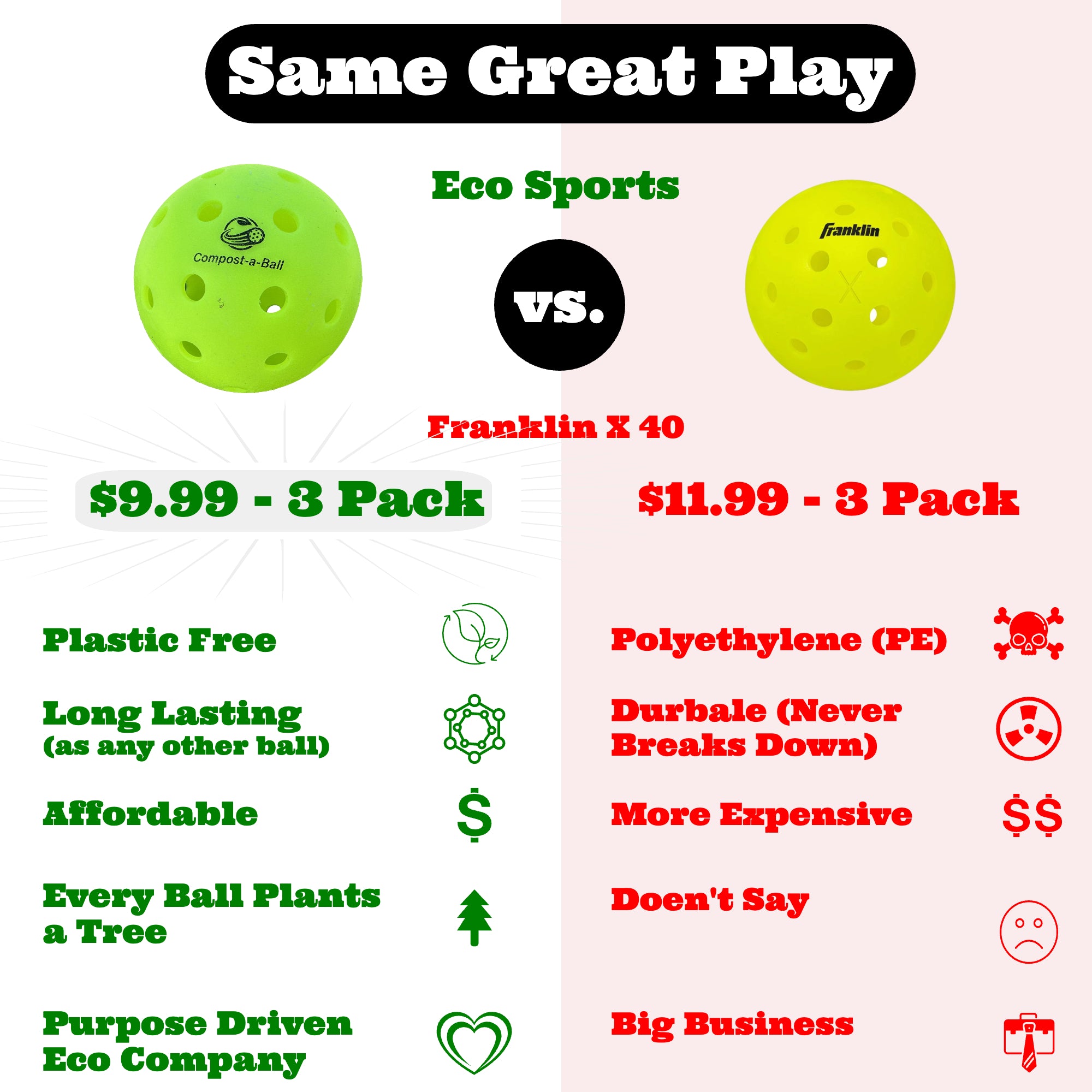
The EV-11 rounds out the podium with a different philosophy from the two balls above it. Instead of engineering the ball to disappear, Evolute cuts virgin plastic going in — 10% reclaimed ocean-bound plastic — and builds the ball from fully recyclable #2 MDPE so spent balls can come back out of the waste stream. The payoff is familiarity: a durable-plastic feel, consistent bounce, and honest per-ball pricing (~$3.50 in a 12-pack) with no premium over the Franklin X-40s in your bag now. It's the pragmatist's eco ball — incremental footprint reduction with zero adjustment period.
Key Specs: 40-hole outdoor design | #2 MDPE with 10% reclaimed ocean-bound plastic | Fully recyclable | Sold in 3- and 12-packs
Best Innovation / Most Durable: Accel Digital Sports DigiPro 3.0
$29.97 per ball
What We Like
- First-ever 3D printed pickleball, made in the USA from recycled thermoplastic elastomer
- One ball is engineered to replace 10–20 standard balls
- Over 10 decibels quieter than a standard pickleball — approved by USA Pickleball for quiet play
- Regulation 30–34 inch rebound with zero warping, consistent across surfaces and temperatures
What to Consider
- $29.97 for a single ball is a real sticker shock, even if the per-game math works out
- Quiet-play approval is not the same as standard tournament approval — check your event's rules
- The softer "click" off the paddle takes an adjustment period
The DigiPro 3.0 is the most genuinely new idea in pickleballs in years. Michigan-based Accel Digital Sports prints each ball on HP Multi Jet Fusion machines — the industry's most advanced additive manufacturing process — using recycled material, producing a lattice-style ball that simply doesn't crack or go out of round the way injection-molded balls do. The company's durability claim, that one DigiPro replaces 10 to 20 standard balls, reframes the price: at the midpoint, you're paying roughly $2 per conventional-ball-equivalent while generating a fraction of the waste. The headline feature, though, is sound. At over 10 decibels quieter than a standard ball, it's the answer for HOA disputes, noise-restricted courts, early-morning drilling, and indoor facilities — and it's USA Pickleball approved for quiet play. If your courts are threatened by noise complaints, this ball is cheaper than losing them.
Key Specs: 3D printed recycled TPE | 10+ dB quieter than standard balls | USA Pickleball quiet-play approved | Made in USA | Sold individually and in Duo sets
Best for Fast, Aggressive Play: Accel Digital Sports DigiPro 3.1 Fast-Play
$29.97 per ball
What We Like
- Same 3D printed recycled construction and 10+ dB noise reduction as the 3.0
- Tuned faster off the paddle for players who found the 3.0 too controlled
- Same extreme durability — no cracking, no warping
- Available in a Duo Set with the 3.0 to compare both feels
What to Consider
- Same premium single-ball price
- Bangers used to a Dura-style rock will still notice a softer impact feel
Accel's follow-up answers the main critique of the original: pace. The 3.1 Fast-Play keeps everything that makes the DigiPro platform special — recycled-material 3D printing, the quiet signature, the refuses-to-die durability — and adds speed for drivers, counter-punchers, and anyone whose game is built on pace. If you're intrigued by 3D printed balls but play an aggressive style, start here; better yet, the DigiPro Duo Set pairs a 3.0 and 3.1 so you and a partner can settle the control-versus-speed question on court.
Key Specs: 3D printed recycled TPE, fast-play tuning | 10+ dB quieter than standard balls | USA Pickleball quiet-play approved | Made in USA | Sold individually and in Duo sets
Best for Bulk Buyers: CORE ECO Bulk Packs
$29.99 per 12-pack (~$2.50/ball) | $99.99 per 50-pack (~$2.00/ball) | $450 per 300-pack ($1.50/ball)
What We Like
- The best per-ball pricing in the entire eco category at case quantities — down to $1.50/ball
- Same USAPA tournament-approved, ASTM-certified ball as our Best Overall pick
- Pack range (12, 50, 300) fits everyone from a rec group to a multi-court facility
- One ball for open play, clinics, and leagues keeps play consistent club-wide
What to Consider
- The 300-pack is a real commitment — split it with a neighboring club if you're unsure
- Larger packs periodically sell out; plan ahead of your season
Clubs, coaches, and leagues buy balls by the case, and this is where the CORE ECO becomes unbeatable: the 50-pack lands at about $2.00 per ball and the 300-pack at $1.50 — cheaper than conventional tournament balls, for a certified biodegradable, tournament-approved ball. For any facility with a sustainability mandate (or just a budget), the math does the arguing. Buying the same ball your players already use in 3-packs also means no feel change between casual sessions and organized play.
Key Specs: Same ball as Best Overall pick | 40-hole outdoor design | ASTM-certified biodegradable | USAPA approved | 12, 50, and 300-packs
How We Selected
We started with every eco-positioned pickleball we could verify on the market in 2026 and cut anything that failed three screens. First, regulation credibility: the ball needed published specs consistent with USA Pickleball standards (26–40 holes, ~2.87–2.97 in diameter, 0.78–0.935 oz, ~30–34 in rebound) and, ideally, USAPA approval for standard or quiet play. Second, a substantiated sustainability claim: a named material, a stated timeframe, and where possible third-party verification (ASTM testing, independent decomposition studies) — vague "planet-friendly" copy didn't count. Third, real-world performance: player and reviewer feedback on bounce, spin, flight, and durability against benchmarks like the Franklin X-40 and Dura Fast 40. Final rankings weighed performance and durability most heavily, because a green ball nobody wants to play with helps no one.
What to Look For in an Eco-Friendly Pickleball
USAPA approval. This is your regulation-quality guarantee. Note the distinction between standard approval (sanctioned tournament play) and quiet-play approval (like the DigiPro line) — both are certified, but they're different lists.
The actual material. "Eco" spans three different strategies: biodegradable plastics (Komodo, CORE ECO), recycled/recyclable plastics (Evolute), and 3D printed recycled elastomers (Accel). Each makes a different promise about where the ball comes from and where it ends up.
Durability — the stealth sustainability metric. A ball that lasts ten times longer prevents more waste than almost any material change. It's also where your money goes: judge cost per hour of play, not sticker price. A $29.97 DigiPro replacing 10–20 standard balls is cheaper per game than a $3.50 ball that cracks in a week.
Indoor vs. outdoor design. Outdoor balls use 40 smaller holes and harder construction for wind and rough surfaces; indoor balls use 26 larger holes. Nearly every eco ball today is an outdoor design — check before buying for gym play.
End-of-life claims with numbers. Credible brands state a timeframe (400 days, 3–5 years) and a testing basis. All plastic "biodegrades" eventually; only a number makes the claim meaningful. Beware listings with no material disclosure, no specs, or no return policy — in balls, quality control is the product, and suspiciously cheap no-name multi-packs fail all three tests.
Noise, if your courts are contested. Ball noise is now a real threat to court access in residential areas. If your club faces complaints, a quiet-play-approved ball isn't a nice-to-have — it's how you keep playing.
Frequently Asked Questions
Are eco-friendly pickleballs legal for tournaments?
Several are USA Pickleball approved — the CORE ECO and Komodo BioBall for standard play, and the DigiPro line for quiet play. Sanctioned tournaments usually mandate one specific official ball, though, so check your event's rules. For rec play, leagues, and clubs, any approved ball on this list is fully legitimate.
Do they play differently from a Franklin X-40 or Dura Fast 40?
Each has its own personality, just as the X-40 and Dura differ from each other. The biodegradable and recycled-plastic balls (CORE ECO, BioBall, EV-11) feel closest to conventional balls. The 3D printed DigiPros feel and sound noticeably different — softer impact, much quieter — and reward a session or two of adjustment. Give any new ball three sessions before ruling on it.
Will a biodegradable ball break down in my bag or in the rain?
No. Decomposition requires sustained landfill conditions — microbes, moisture, and months of time. Rain, humidity, sweat, and a hot trunk won't harm them. Store and play them like any other ball.
Is a 3D printed ball really worth $30?
Do the math for your situation. If one DigiPro genuinely replaces 10–20 standard balls, the per-ball-equivalent cost is $1.50–$3.00 — at or below what you pay now — with a fraction of the waste. If you play twice a month on smooth courts, a cheaper certified ball like the CORE ECO makes more sense.
What should I do with a cracked eco ball?
Follow the brand's guidance: EV-11s go in #2 plastic recycling where accepted, and biodegradable balls like the CORE ECO and BioBall are designed to break down even in ordinary landfill — the exact scenario they were engineered for.
Which one should I buy first?
For most players: the CORE ECO — tournament approved, ASTM certified, and the cheapest way to make the switch. If durability is your top priority: the Komodo BioBall. Fighting noise complaints or tired of cracked balls: DigiPro 3.0 (or 3.1 if you hit hard). Stocking a club: CORE ECO by the case — the 50- and 300-packs drop to $2.00 and $1.50 per ball.
Why Trust This Guide
This guide was written by a 6.0+ DUPR, Top 100 professional pickleball player who tours, teaches, and puts balls through daily court time. Rankings are grounded in USA Pickleball approval status, manufacturer specifications, third-party testing claims (including ASTM-certified decomposition data and independent durability studies), and aggregated player reviews — then weighed with the priorities of a competitive player: a true bounce, honest spin response, and durability that holds up to real play. Every product was evaluated against the same criteria.