
Sustainable basketballs that grip, bounce, and last like the big brands — without the leather or the toxins.
Written by a 6.0+ DUPR, Top 100 professional pickleball player and lifelong multi-sport athlete.
Basketball has a materials problem most players never think about. Traditional indoor balls are wrapped in cowhide leather or PU/PVC "composite leather" — plastics that shed microplastics, often carry plasticizers like phthalates, and can't be recycled. Outdoor rubber balls fare little better: petroleum-based, quick to wear bald on asphalt, and destined for the landfill. With millions of basketballs produced every year, a small but real market of eco-friendly alternatives has finally emerged — vegan TPU covers and even a 3D printed ball that never needs air.
To find the best of them, we evaluated every eco-positioned basketball we could verify on the market in 2026 on grip and playability, durability, materials and toxicity, sustainability substance, and value. Here are the four that earned a spot.
Our Top Picks
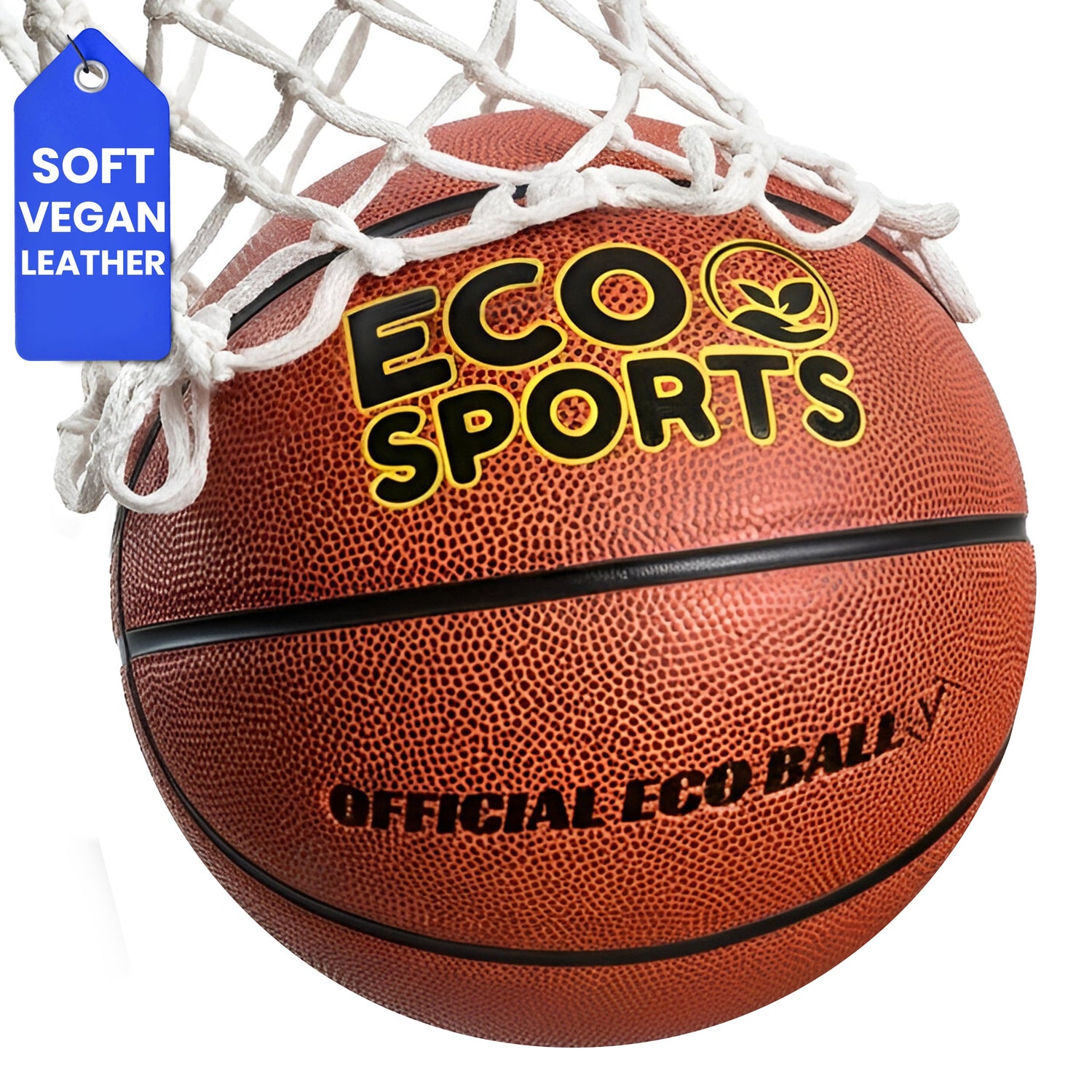
- Best Overall: Eco Sports Indoor Basketball (TPU Vegan Leather)
- Best Outdoor / Best Budget: Eco Sports Green Basketball
- Best Innovation: Wilson Airless Gen1
- Best for Teams & Schools: Eco Sports Basketball Team Pack
Best Overall: Eco Sports Indoor Basketball (TPU Vegan Leather)

$37.99–$39.99 | Sizes 5 (27.5"), 6 (28.5"), and 7 (29.5") | Shop it here
What We Like
- TPU (thermoplastic polyurethane) vegan leather cover — no cowhide, no PU/PVC plastics
- Non-toxic construction: free of BPA, PFAS, lead, and phthalates
- TPU is recyclable, unlike the thermoset rubber and PVC composites on conventional balls
- Grippy, leather-like feel with consistent bounce, in men's, women's/intermediate, and youth sizes
- Every purchase plants a tree; free US shipping and 30-day returns
What to Consider
- Priced slightly above entry-level rubber balls (though below premium composites like the Wilson Evolution)
- A young brand without the decades of pro-league pedigree of Spalding or Wilson
The Eco Sports indoor basketball wins the top spot because it fixes the category's two dirty secrets — animal leather and toxic plastics — without asking you to play with a compromise ball. The TPU cover mimics the soft, tacky feel of a premium composite while being verifiably free of BPA, PFAS, lead, and phthalates, which matters when you think about how many hours your hands (or your kids' hands) spend on a ball. TPU is also a thermoplastic, meaning it can be melted down and recycled instead of sitting in a landfill for centuries like PVC composites and vulcanized rubber. It comes in all three standard sizes at a price in line with mainstream mid-range balls, and the mission is more than one SKU deep: Eco Sports runs its entire catalog on non-toxic vegan materials and plants a tree with every order. For most players making the switch, this is the ball.
Key Specs: TPU vegan leather cover | BPA, PFAS, lead & phthalate free | Recyclable cover material | Sizes 27.5", 28.5", 29.5" | Indoor/outdoor
Best Outdoor / Best Budget: Eco Sports Green Basketball

$24.99 | 29.5" (men's) and 27.5" (youth) | Shop it here
What We Like
- Same non-toxic, vegan TPU construction as our Best Overall pick at a lower price
- Built for outdoor courts — abrasion-resistant cover that stands up to asphalt and concrete
- Signature green-and-blue colorway is easy to spot at a crowded park
- The cheapest way into a non-toxic ball, and a natural gift pick
What to Consider
- Two sizes only — no 28.5" intermediate option in this colorway
- Bold colorway isn't for players who want a traditional-looking ball
Outdoor courts are where basketballs go to die, which makes durability the real sustainability metric on asphalt. The Eco Sports green ball brings the brand's TPU cover to a $24.99 price point that undercuts most name-brand outdoor balls while staying free of the BPA, phthalates, and PFAS that leach out of conventional rubber and PVC as they wear down on rough surfaces. It grips well in dust and heat, holds air and shape, and the two-tone colorway means it never gets mixed up with the park's communal balls. For casual players, kids, and anyone who wants one honest ball for the driveway, start here.
Key Specs: TPU vegan leather cover | Non-toxic | Outdoor-rated | 29.5" and 27.5" | Green/blue colorway
Best Innovation: Wilson Airless Gen1

$2,500 | Limited release | See it at Wilson.com
What We Like
- First 3D printed airless basketball ever sold — a polymer lattice with hexagonal holes that never needs inflation
- Regulation size, weight, and bounce, engineered to replicate a standard ball
- Additive manufacturing produces each ball in a single piece with no offcut waste, versus the eight cut panels and four layers of a traditional ball
- A genuine glimpse at where sustainable ball manufacturing is headed
What to Consider
- $2,500 makes it a collector's piece, not a rec-league purchase — and initial runs sold out fast
- Wilson acknowledges the Gen1 isn't yet fully recyclable
- Zero-waste manufacturing isn't the same as a sustainable material story
The Airless Gen1 earns its slot as proof of concept, not as your next game ball. Wilson 3D prints the entire ball as one continuous see-through lattice — no bladder, no valve, no panels, no glue — so it can never go flat and produces essentially no manufacturing scrap. It debuted at the NBA All-Star Game and sold out its $2,500 retail run almost immediately. The honest caveats: it's a first-generation product, it isn't fully recyclable yet (Wilson says it wants to get there), and the price puts it firmly in trophy-case territory. But as 3D printing did for the DigiPro pickleball, the Airless points at a future where balls are printed on demand from recycled polymer with zero waste — and that future is worth watching.
Key Specs: 3D printed polymer lattice | Airless — never needs inflation | Regulation size and bounce | Limited availability
Best for Teams & Schools: Eco Sports Basketball Team Pack

$220–$240 for 10 balls ($22–$24/ball) | Men's 29.5", Women's 28.5", or Youth 27.5" | Shop it here
What We Like
- Ten non-toxic TPU basketballs at a per-ball price below most single name-brand balls
- One size-matched case for a team, PE program, camp, or league
- Same BPA/PFAS/lead/phthalate-free construction as the Best Overall pick — which matters most when the hands on the ball are kids'
- Ten trees planted per pack
What to Consider
- Balls ship deflated — budget a session with a pump before practice
- Women's 28.5" packs periodically sell out; order ahead of your season
Schools and youth programs replace basketballs constantly, and they're also exactly the buyers who should care most about what's in the cover material — small hands, long practices, and equipment budgets that reward durability. The Eco Sports team pack solves the whole equation at once: ten balls in your choice of size for $22–$24 each, in the same recyclable, toxin-free TPU as the flagship ball. For athletic directors and coaches with any sustainability mandate (or just a parent group that asks questions), this is the easiest procurement decision in the category.
Key Specs: 10 balls per pack | TPU vegan leather | Non-toxic | Single-size packs: 29.5", 28.5", or 27.5" | Ships deflated
How We Selected
The eco basketball category is young, so we started by verifying which "sustainable" basketballs actually exist and are purchasable in 2026 — a shorter list than the marketing suggests. Every pick had to clear three screens. First, playability: regulation sizing, honest bounce, and a cover you'd willingly run games with. Second, a substantiated eco claim: a named material (TPU, 3D printed polymer), a verifiable certification, or a documented non-toxicity standard (BPA, PFAS, lead, phthalate free) — vague "green" packaging didn't count. Third, availability: every pick must be purchasable today from a live product page — we cut brands whose stores have gone dark, and where big brands offered commitments instead of products, we covered them in the brand overview rather than inventing a pick.
What to Look For in an Eco-Friendly Basketball
The cover material — this is the whole ballgame. Conventional balls use cowhide leather (an animal product with a heavy tanning footprint), PU/PVC composites (microplastic-shedding, non-recyclable), or petroleum rubber. The eco alternatives are TPU (recyclable, non-toxic, leather-like feel) and printed polymers. Ask what the ball is made of; if the listing won't say, that's your answer.
Non-toxicity, not just sustainability. A basketball spends hours in contact with skin, and cheap PVC covers can carry phthalates, BPA, and other additives. Look for balls verified free of BPA, PFAS, lead, and phthalates — especially for kids.
Durability as an environmental metric. The greenest ball is the one you don't replace. Outdoor players should weight abrasion resistance heavily; a ball that survives three seasons beats a "greener" ball that goes bald in one.
Indoor vs. outdoor design. Soft premium covers built for hardwood shred on asphalt. Match the ball to your primary surface, and if you split time, buy the outdoor-rated option.
Certifications and receipts. Named testing for toxin-free claims, published material disclosures, and documented recyclability. Brands with documentation lead with it; brands without it lead with leaf icons.
The brand behind the ball. One green SKU in a conventional catalog is a marketing test. A catalog built entirely on non-toxic materials, tree-planting programs, and take-back schemes is a mission. Buy from the mission.
Brand Overview: Where the Big Names Stand
The major manufacturers are moving, but slowly. Wilson has publicly committed to increasing recycled content in its basketballs and its Airless project shows real R&D investment in low-waste manufacturing. Spalding has experimented with recycled rubber and synthetic leather alternatives in parts of its line. Neither yet offers a flagship ball with the material transparency of the small eco brands — no published toxin testing, no recyclable cover, no certification trail. Until they do, the substance in this category lives with the specialists: Eco Sports on non-toxic vegan TPU, and Wilson's skunkworks on printed, airless construction.
Frequently Asked Questions
Do vegan/TPU basketballs play like leather or composite balls?
Yes — TPU was engineered to mimic leather, which is exactly why the sneaker industry adopted it. Expect a grippy, slightly tacky feel comparable to a mid-to-premium composite, with consistent bounce. As with any new ball, give it a few sessions to break in and for your hands to adjust.
Are eco basketballs regulation size and weight?
The Eco Sports balls come in standard 29.5", 28.5", and 27.5" sizes at regulation weights, and the Wilson Airless Gen1 replicates regulation size, weight, and bounce. For sanctioned league play, check your league's approved-ball rules — most rec leagues simply require correct size and inflation.
What makes a basketball "non-toxic"?
Verified absence of the additives common in PVC and cheap synthetics: BPA, phthalates (plasticizers), PFAS (forever chemicals), and lead in surface coatings. This matters because ball covers wear down with use — whatever is in the cover ends up on hands and courts.
Is TPU really better for the environment?
It's meaningfully better on two counts: it's recyclable (PVC composites and vulcanized rubber aren't), and it's produced without the toxic plasticizers PVC requires. It is still a plastic — the gains are in recyclability, toxicity, and longevity rather than biodegradability. No mainstream basketball is biodegradable yet.
Why is the Wilson Airless $2,500?
It's a first-generation, limited-run product made on industrial 3D printers — you're paying for the manufacturing method and the collectible, not cost-efficient production. Treat it as a preview of the technology, not a value proposition.
What should I do with my old basketball?
Donate playable balls to schools, community centers, or programs like Eco Sports' used-equipment donation page. Dead conventional balls unfortunately have no recycling path — one more argument for making the next ball a recyclable one.
Why Trust This Guide
This guide was written by a professional athlete — a 6.0+ DUPR, Top 100 pro pickleball player — who grew up on court sports and evaluates equipment for a living. Rankings are grounded in verified product specifications, published material and certification claims, and player feedback, weighed with a working athlete's priorities: grip, true bounce, and durability that survives real use. Every product was evaluated against the same criteria.
